Showing posts with label world cup food. Show all posts

Sunday, 31 May 2015

Recipes for the Women's World Cup 2015

Brazilian feijoada was the first dish featured on this blog's World Cup 2014 celebration

The FIFA Women's World Cup 2015 is being hosted in Canada and begins next Saturday, 6th June. An initial 24 teams from nations around the world will contest the event. While women's football/soccer is often unjustly scorned by many male fans, there is no doubt there will be a great deal of top quality entertainment provided throughout the tournament with some very skillful players on show.

Beef stuffed bell peppers represented Bosnia in 2014

Food of course plays an integral part in a large sporting event of any type. Last year, when the men's World Cup 2014 was being played in Brazil, I ran a feature on this blog incorporating traditional recipes from many of the participating countries, each creation given my own special little twist. I thought about doing similar for the Women's World Cup in Canada with different dishes of course but then I came up with an alternative option.

This beautiful tapas platter was the Spanish dish for World Cup 2014

What I am going to do is look at some of the matches taking place in the World Cup and create in each instance a fusion dish to hopefully represent both participating countries. I think this affords a great opportunity to devise new recipes I would probably never otherwise have considered and I hope to find at least a few which work well enough that I'll want to prepare them again and again.

Spicy meat and potato hotpot was the featured dish from Cameroon

I will publish each dish a couple of days or so before the relevant match takes place, allowing anyone who likes the idea plenty of time to assemble the necessary ingredients and prepare the dish to enjoy perhaps while watching the particular match. It may be a means of adding extra interest and fun to the occasion, especially if your country is involved in the match and you are having friends over to enjoy the occasion as a group.

Canard au vin (duck in wine) was my French dish for World Cup 2014

The first recipe will be published this coming midweek and will be dedicated to the opening Women's World Cup fixture which sees the hosts Canada take on China. It will feature typically Canadian and Chinese ingredients, hopefully blended together in an attractive and tasty fashion. Want to see what I come up with for this match and more? Why not follow this blog by e-mail via the option in the right hand margin and be notified as soon as the posts are up?

Sole meuniere was the dish prepared to represent Belgium for Brazil 2014

Regardless of who ultimately lifts the trophy, let's hope we see a great spectacle, enjoy some great games and see women's football elevated as a result to new levels of popularity, all the while enjoying some great food of many different types from a variety of countries and cuisines around the world.

Chacarero Chileno was my dish created for Chile in Brazil 2014

Monday, 14 July 2014

World Cup Food Recipes - Germany

Roast pork on potato pancake with bratwurst sausages and sauerkraut

Germany last night defeated Argentina in extra-time to become FIFA World Champions for a fourth time overall but for the first time since 1990. No one could surely argue with the outcome of what was a magnificent tournament as the teamwork displayed by the Germans virtually throughout was exemplary. Yes, other teams had their big name stars who shone on the big stage but the German work ethic and unity ultimately paid dividends and earned them the right to lift the biggest prize in sport. I cooked this German meal last night and actually ate it while watching the final.

Sadly, this is the last of my featured recipes relating specifically to the 2014 World Cup. It doesn't seem like more than four weeks ago that I undertook to feature a recipe from as many of the participating countries as possible. This is the twenty-third recipe from the thirty-two participating nations. I have to apologise to those nine countries which I didn't manage to feature. This was down to a variety of reasons including unavailability of appropriate ingredients, an oven disaster in the case of England (I lost track of time and the dish was burned) but most of all to simple time constraints. I may try to feature something from at least some of those countries in the near future.

Roast Pork on Potato Pancake with Bratwurst and Sauerkraut

This recipe is based around a dish served in Bavaria called a schweinshaxe. A traditional schweinshaxe is a roasted knuckle of pork, served on the bone, popularly with gravy, potato dumplings and sauerkraut. I featured such a recipe on this blog a few years back. The main difference here is that I have removed the pork from the bone after it is cooked and rested, before serving it on an (almost) authentic German potato pancake with some (supermarket bought) sauerkraut and some totally authentic German bratwurst sausages.

Pork knuckle ready for roasting

Ingredients

1 pork shank/hock
Vegetable oil
Salt and black pepper
1 egg
1 tablespoon plain/all purpose flour
1 medium baking potato
1 clove of garlic
1/2 teaspoon dried thyme
White pepper
6 bratwurst
Sauerkraut as required/desired
Freshly chopped parsley to garnish
1 bottle of German beer to serve

Flour is added to beaten egg

Directions

The first step is to get the pork on to roast. Your oven will need to be preheated to 200C/400F/Gas Mark 6. You will also need to know the weight of the pork knuckle in order to calculate the cooking time of 35 minutes per pound and 35 extra minutes. Conveniently, this piece of pork weighed exactly two pounds, meaning a cooking time of one hour and forty-five minutes was required.

Lightly oil a roasting tray (to help prevent the pork sticking) and season the pork well with salt and black pepper. Lay it on the tray and put it in the oven for your calculated cooking period of time.

Around quarter of an hour before the pork is due to come out of the oven, beat the egg in a fairly large bowl and subsequently beat in the flour to form a smooth batter paste.

Potato and garlic are peeled and grated

Peel the potato and use a box grater as seen in the photo above to grate it on the coarsest side in to the centre of a spread out, clean tea towel. This is to easily allow you to squeeze the water out of the potato. If you don't do this, your pancake will not set properly in the pan.

Potato is grated in to a clean tea towel

Gather up the corners of the tea towel and over your sink, twist and squeeze to get rid of the water. You may be surprised by how much comes out!

Preparing to squeeze water from grated potato

Add the squeezed and grated potato to the flour and egg batter. Peel the garlic clove and grate it in to the bowl with a small hand grater. Season with salt, white pepper and the half teaspoon of thyme. Stir well to evenly combine and refrigerate for fifteen minutes.

Potato, garlic and seasonings are stirred through flour and egg batter

When you take the pork from the oven, pierce the thickest part with a skewer to ensure the juices run clear. Cover with kitchen foil and leave to rest/partly cool for fifteen minutes.

Roast knuckle of pork

The bratwurst could be grilled/broiled but I find you get much better results if you fry them fairly gently in a little vegetable oil in a frying pan.
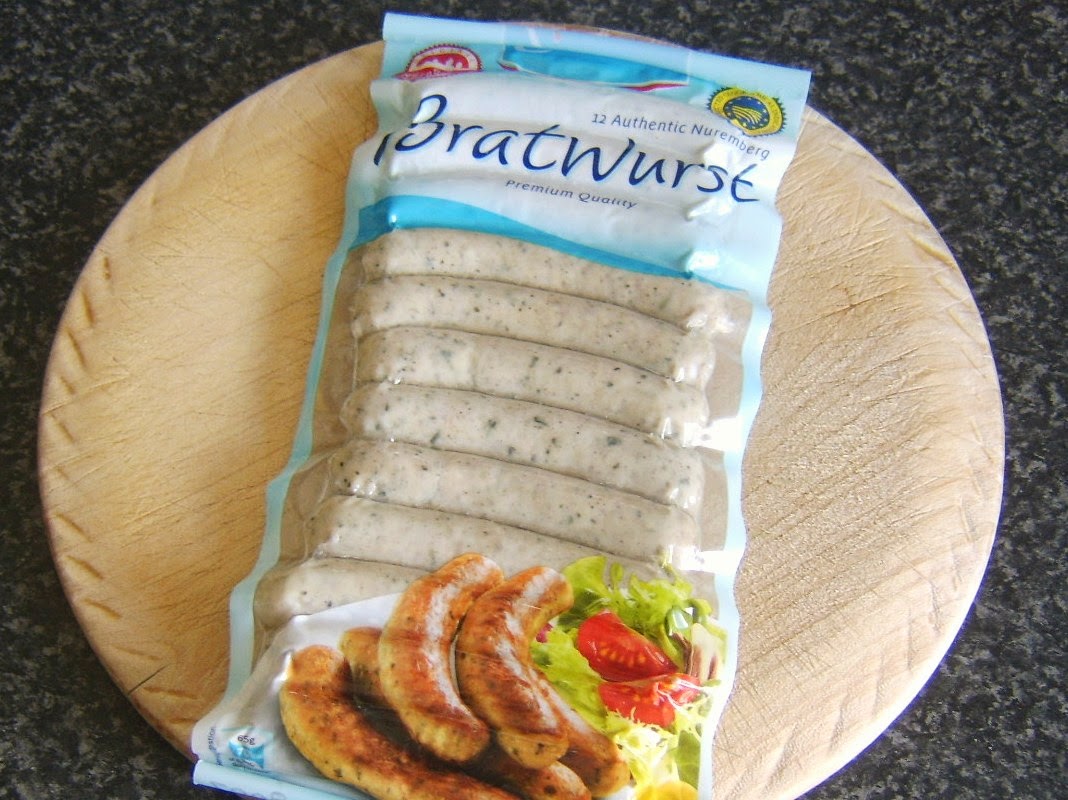
Authentic German bratwurst sausages

Bring around a tablespoon of oil up to a medium heat in a non-stick frying pan. Add the bratwurst and cook on low to medium for around ten minutes until done, turning them around in the pan frequently.

Bratwurst sausages are gently fried in oil

The crackling/skin on the pork is considered by many to be the best part of the joint! I disagree. Not only is it unhealthy (pure fat), I find it plays havoc with my teeth. I therefore cut it/pull it off and discard it. Whether you do likewise or eat it is up to you.

Crackling is cut from roast knuckle of pork

The majority of the pork can be cut from the bone using a carving fork and knife. The final bits however will have to be pulled free by hand.

Roast pork removed from the knuckle bone

Pour a tablespoon or two of oil in to a second pan and bring up to a medium heat. Carefully spoon in the potato pancake batter and cook for three or four minutes before turning with a spatula to cook for a similar period of time on the second side.

Frying potato pancake batter

Lay the potato pancake and sausages on a serving plate. Spoon on your sauerkraut around the edges.

Potato pancake, sauerkraut and bratwurst sausages

The pork is served on the pancake. I'm not a gravy fan but if you wanted to make a simple gravy from the pork cooking juices, this would work very well poured over the top. Instead, I simply garnsihed with some chopped parsley, opened my weissbier and tucked in. Prost!

Authentic German beer is served with the best German meals

Friday, 4 July 2014

World Cup Food Recipes - Croatia

Cuspajs is a simple but delicious Croatian cabbage and potato soup

Croatia were drawn in Group A of the World Cup and helped open the tournament with a match against their hosts, Brazil. They were largely uninspiring, losing by the same 3-1 scoreline firstly to Brazil and subsequently to Mexico. A 4-0 victory in between these two matches over Cameroon consequently proved meaningless in terms of qualification.

Croatian Cuspajs (Cabbage and Potato Soup)

It is not especially easy to identify traditionally Croatian dishes. This is due to the political upheaval the region has endured - particularly in recent decades - as well as the extensive influences Croatian cuisine has known from the likes of Austria, Hungary and Greece. Although this soup sounds very basic, it is genuinely Croatian and really is surprisingly delicious - I promise! I've made a couple of significant ingredient changes by using a white cabbage rather than a green one and red onion rather than white/yellow. I've also simplified the cooking procedure as most recipes seem to make it what seems to be unnecessarily long and complicated.
 
Main vegetable ingredients for cuspajs

Ingredients (Serves Four)

1/4 white cabbage, core cut out and roughly shredded
1 medium baking potato, peeled and diced to around 3/4 inch
1/2 green bell pepper, seeded and roughly chopped
Salt and pepper
Water as required
1 ounce (1/4 stick) butter
1/2 small red onion, peeled and moderately finely chopped
1 teaspoon plain/all purpose flour
1 teaspoon paprika
Chopped parsley to garnish

Prepared vegetables and seasonings are added to soup pot

Directions

Add the cabbage, potato and green bell pepper to a large soup pot. Season well with salt and pepper and pour in enough cold water to ensure everything is comfortably covered to a depth of about an inch.

Water is added to vegetables, the mix is stirred and brought to a simmer

Stir the mix carefully but well with a wooden spoon and put the pot on to a high heat. When the water starts to boil, reduce the heat and simmer for about twenty-five minutes until the potatoes and cabbage have just softened.

Starting to prepare zafrig, a Croatian soup thickening agent

When the soup has been simmering for about fifteen minutes, it is time to prepare the zafrig - the soup thickening agent. It works on a similar basis to a roux for thickening sauces.

Put the butter and the red onion in to a separate large soup pot and on to a gentle heat to melt the butter. Fry off the onions in the melted butter for a couple of minutes until soft and glistening.

Flour and paprika are added to softened onions in butter

Add the flour and paprika to the butter and onion and stir to form a thick paste. Cook off for a minute or so before adding one ladleful of liquid from the soup to free it up a bit. SImmer as gently as possible for five minutes to cook off the flour.

Cuspajs is ready to be added to zafrig

The cuspajs (soup) now has to be added to the zafrig  (thickener) and not the other way around. For safety reasons and to avoid potentially scorching splashes, this is best done with a ladle.

Cuspajs is carefully ladled in to zafrig

Take your time combining the two components but you should find it won't take long.

Cuspajs and zafrig are stirred together and brought to a simmer

Stir the soup well and bring to a simmer for ten final minutes, stirring occasionally, until the zafrig has done it swork and caused the cuspajs to thicken.

Thickened cuspajs is ready to serve

Ladle the cuspajs in to serving dishes, garnish with the chopped parsley and serve.

Cuspajs is carefully ladled in to a soup serving bowl

Tuesday, 1 July 2014

World Cup Food Recipes - Switzerland

Assorted vegetables with melted cheddar cheese dip

Switzerland secured qualification from Group E along with France by way of a 3-0 final game victory over Honduras. Later today, however, they face a much stiffer test when they come up against the might of Argentina and the incredible talents of a certain Lionel Messi. If there is one thing, though, from which the Swiss can take heart it is that several bigger teams have already departed this incredible World Cup earlier than expected and anything can clearly happen in a one-off encounter.

Vegetable Fondue Sharing Platter

Fondue is something which many people incorrectly believe to be of French origin. It is actually from Switzerland. The traditional, basic form of fondue sees bread dipped in to a pot of melted Swiss cheese but the concept has evolved considerably in particularly more recent times. This version of fondue sees a variety of tasty vegetables served for dipping in a Cheddar cheese based sauce.

Fresh cauliflower, broccoli and carrots

Ingredients (Serves Two)

8 small new potatoes
Salt
2 medium to large carrots, topped, tailed and roughly chopped
1/2 large cauliflower, broken in to florets
1/2 large head of broccoli, broken in to florets
4 tablespoons double/heavy cream
1/2 teaspoon ground nutmeg
Good shake of Worcester sauce
4 ounces Cheddar cheese, coarsely grated
1 tablespoon freshly chopped parsley

New potatoes are firstly cooked by boiling

Directions

Wash the potatoes and put them whole and unpeeled in to a pot of salted cold water. Bring the water to a simmer for about half an hour until the potatoes are just cooked. Drain, return to the empty pot, cover and leave to cool completely.

Carrots are roughly chopped and simmered in salted water

Put the carrot pieces in to a pot of cold salted water and bring to a simmer for ten to fifteen minutes until just softened but still with a little bit of "bite" to them.

Broccoli and cauliflaower are cooked together in one large pot

The broccoli and cauliflower florets should be added to a pot of boiling, salted water for eight minutes.

Sectioned plate is heated before vegetables and cheese are added

Fondue will normally see the cheese served over a heat source to keep it warm and fluid. In this instance, it is merely going to be served in the central well of a section plate but it is vital the plate firstly be heated. Put it in to your oven on its lowest setting for around ten minutes.

Cheese ready for grating

Make sure the cheese is grated and ready to go before you start heating the cream as the sauce mixture will require constant monitoring.

Deep frying halved potatoes

The cooled potatoes should be halved before being deep fried in hot oil for about four or five minutes until crisp and golden.

Seasoned cream is gently heated

Pour the cream in to a small saucepan and season with the nutmeg and Worcester sauce. Bring to a gentle simmer, stirring frequently with a wooden spoon.

Deep fried potatoes are drained on kitchen paper

Drain the potatoes on some kitchen paper on a plate.

Grated cheese is added to heated cream

Add the cheese to the simmering cream, continuing to heat on the lowest possible setting.

Vegetables for dipping in to cheese are plated

Drain the carrots, cauliflower and broccoli. Arrange the vegetables on the hot serving plate as shown.

Parsley is added to melted cheese

Stir the parsley in to the melted cheese before pouring in to the plate well to serve.

Wednesday, 25 June 2014

World Cup Food Recipes - Uruguay

Pollo con vegetales (chicken and vegetables) in a rich white wine gravy

Uruguay qualified for the last 16 of the World Cup yesterday (Tuesday) with a 1-0 win over Italy. Sadly, the biggest talking point by far after the match was the "alleged" incident involving controversial striker Luis Suarez and what action if any FIFA are likely to take retrospectively. That is something upon which the football world still awaits clarification at the time of writing but one thing is for sure, negativity like this should not be allowed to in any way overshadow what has largely been a wonderfully competitive and entertaining World Cup so far.

Uruguayan Pollo con Vegetales (Chicken and Vegetable Stew)

This delicious stew sees pieces of on the bone chicken stewed with a variety of vegetables in a thick white wine sauce. I've used chicken thighs but chicken drumsticks or even on the bone breast portions would work equally well. The secret is in the fact that the chicken must be on rather than off the bone.

Uruguayan chicken and vegetable stew ingredients

Ingredients (Serves One)

2 chicken thighs
2 tablespoons vegetable oil
1/2 medium white onion, sliced
2 large garlic cloves, peeled and sliced
Salt and pepper
1/2 teaspoon dried thyme
1/2 teaspoon dried rosemary
6 small new potatoes
1 small carrot, washed, topped, tailed and chopped
6 small button mushrooms
2 teaspoons plain/all purpose flour
1/4 pint fresh chicken stock
1/4 pint dry white wine

Vegetables prepared for stew

Directions

Pour the vegetable oil in to a large stew pot and bring it up to a medium heat. Add the chicken thighs and take two or three minutes to brown and seal them all over, turning them around frequently with cooking tongs.

Browning chicken thighs in hot oil

Add the onion and garlic to the pot, along with the seasonings/herbs. Stir fry for another minute or two.

Garlic and onion are added to chicken thighs

The rest of the vegetables can then be added to the pot. I also scattered in the flour at this stage. This meant that the simple act of adding the liquids would help disperse the flour more evenly.

Remaining vegetables and flour are added to browned chicken

Pour the chicken stock and wine in to the pot and stir carefully but well. Turn up the heat just until the liquid nears a boil then reduce to achieve a gentle simmer. Cover and continue to simmer as gently as possible for half an hour.

Chicken and vegetable stew is brought to a simmer

Turn off the heat and leave the stew to rest for ten minutes. After this time, lift the chicken thighs from the pot to a holding plate with a slotted spoon.

Cooked chicken thighs are lifted from stew

Again using the slotted spoon, lift the vegetables to a serving plate and spoon on some of the sauce.

Vegetables and sauce are spooned in to serving plate

The chicken thighs should be laid on top of the vegetables and the meal is ready to serve.

Tucking in to pollo con vegetales