Showing posts with label salad. Show all posts

Tuesday, 2 August 2011

Summer Salad Platter - A Hearty Meal for One or Side Salad for Four


If the summer heat is continuing to have an effect on your appetite and enthusiasm for food, this really simple summer salad platter may represent the perfect choice for your dinner tonight. It is served cold and the only cooking required is the boiling of the eggs. Alternatively, if you are in a similar position to me, (I am sitting typing this as the wind lashes the rain against my window on a fairly typical, Scottish summer's day) you may wish to prepare this salad and serve it as a side salad to a more substantial meal, for up to four people.

Ingredients per Platter

1 Little Gem (Cos) lettuce
1/2 red onion
4oz soft buffalo mozzarella cheese
12 pitted black olives
2 sticks of celery
1 tbsp raisins
2 tbsp canned red kidney beans
2 tbsp canned haricot beans
2 medium tomatoes
4" piece of cucumber
2 eggs
Salt and freshly ground black pepper
1 tbsp roughly chopped parsley, or other herb of choice, to garnish

Note: You may not of course have a sectioned plate similar to the one I have used upon which to serve your salad platter. If you are interested in obtaining similar plates, I will include some available options at the end of this post.

Method

Ensure that your eggs are at room temperature and not straight from the refrigerator. Place them in a small pot or saucepan and add enough cold water to comfortably cover the eggs. Put the pot on to a high heat until the water begins to boil. Reduce the heat and simmer gently for seven minutes. Take the pot to the sink and run cold water in to it for about thirty seconds, until the eggs are cool enough to be handled. Crack the eggs gently all around on a hard surface, such as your worktop. Shell the eggs carefully under running cold water. Add the shelled eggs to a bowl of cold water to cool them quickly. Allow at least twenty minutes.


Wash the celery sticks and dry them thoroughly. Cut any damaged ends off and discard. Slice the celery across the way to a thickness of around a quarter inch. This should leave you small, kidney-shaped pieces of celery. Mix with the raisins and add to one part of your plate.

Strip the leaves from the lettuce, wash and dry. Shred the lettuce leaves and finely slice the half red onion. Mix together with your fingers, being sure to separate the onion strands. Add to a separate section of the serving plate.

Dice the ball of mozzarella to about half an inch. Half each of the pitted olives. Mix together and plate.

The beans should be of the type canned in water. Wash them in a sieve or colander under running cold water. Shake dry and plate.


When you come to slice the cucumber, do so at a forty-five degree angle. This will give you slightly bigger slices and make for better presentation on the plate. Thinly slice also the tomato and - carefully - the hard boiled eggs. Arrange the tomato, cucumber and egg slices alternately in the centre of the plate.


The parsley or other herb should be washed and roughly chopped. Do not chop and chop away at the herb until you lose all the flavour in the form of a green stain on your chopping board. Scatter it over the salad serving platter, season with salt and pepper and your delicious summer salad platter is ready for the table.


Monday, 23 August 2010

Fillet of Baked Pike with Meuniere Sauce, Salad and New Potatoes


There are a great many people here in the UK who believe either that pike should not be eaten or that it does not afford an enjoyable eating experience. Although I had eaten pike before, in both Austria and the Czech Republic, I had never until very recently had the opportunity to actually cook pike.

That all changed one night last week when I got a phone call to enquire whether I could use a pike which had just been caught. I established that the pike was about two and a half pounds in weight and in good condition. I delightedly therefore accepted the offer and headed off to collect the fish that would form my dinner the following evening.

I gave considerable thought as to how I would cook my pike. On the two previous occasions I remember eating pike, it was on one occasion barbecued and on the other, poached in a fish kettle. In the name of variety and experimentation, I therefore decided to cook it a different way altogether and bake it in the oven.

What I did was gut the pike but otherwise left it whole. I then sat it on a bed of sliced lemon and white onion and made four large scores in the uppermost side of its flesh. I then prepared a very basic meuniere sauce by melting and browning some butter in a saucepan and adding lemon juice and freshly chopped parsley, which I poured over the pike before covering the baking tray with aluminium foil and baking it an oven pre-heated to 375F/190C/Gas Mark 5, for twenty-five minutes.


The cooking of the pike was carried out very late on one evening, so this was the principal reason why I decided to eat it cold the next day. I simply allowed it to cool when it came out of the oven, before refrigerating it whole in a large dish covered with clingfilm until the following evening.

The skin of even a small pike like this is very thick compared to most other edible fish. This actually in a sense makes it easier to remove, however, and by making an incision behind the gill, I was able to strip the skin completely off the uppermost side of the fish. The fillet could then simply be slid from the bones with the aid of a blunt knife and a fish slice. By lifting the head and again using a blunt knife if required, the entire skeleton of the fish should then be lifted away from the second fillet. I then shredded some lettuce and white onion and used it to form a bed for the pike fillet.


I have served the pike fillet here simply with some new potatoes in butter and parsley, some blanched baby corn, cherry tomatoes and a fresh batch of meuniere sauce, made up at the very last minute.

Friday, 26 March 2010

Seared Sea Scallops on BLT Salad with Oven Roasted Potato Slices

Seared Sea Scallops on BLT Salad with Oven Roasted Potato Slices

Scallops are one of my all-time favourite foodstuffs. Their incredibly sweet, delicate flavour and texture is an eating experience in itself, which means it is vitally important that one be extremely careful not to overcook scallops, or to serve them with anything which will overpower their flavour. I have eaten scallops raw - straight from the shell - only minutes after they were hand-plucked from the seabed, I have eaten scallops poached and I have eaten scallops seared in a pan, as in this recipe. Regrettably, I have also had another eating experience with scallops which illustrates perfectly why it is so necessary to be careful when cooking or serving scallops...

It was while living in Edinburgh a few years ago that I visited a top, "European," style restaurant - I will not name the country for fear of causing offence! - to mark a special occasion. (Though believe it or not, I can't remember specifically what the special occasion was!) I knew that it was going to be an expensive night but, well - everyone needs a treat now and again.

As soon as I saw scallops on the menu, I knew what I was having - there was no further decision to be made. I duly ordered them and - given the restaurant's reputation - awaited them as a child would Santa Claus on Christmas morning. I can still remember my horror when the plate was laid before me - I even did a mental check to make sure it wasn't April 1st! The scallops had been completely covered in what was no doubt an elaborately prepared sauce - but to me, given what it was covering, appeared as no more than a destructive yellow slime, equating to an oil-slick on the ocean. I looked up at the young waiter and he looked aghast because he no doubt saw my reaction. I was so shocked, though, I couldn't speak and forced myself to eat the preparation. Needless to say, I tasted nothing of the scallops as their flavour had been completely over-whelmed.

That meal for two (OK - including the wine) cost me mere pennies less than £250.00 (almost US$400.00) and needless to say I never ventured near the establishment again, nor would I ever recommend anyone else do so. Although I had long since known the way scallops could be overwhelmed in such a fashion, that was my first - and hopefully last - experience of it!

The scallops which I cook with come from the cold Atlantic waters off the West Coast of Scotland. The fresher they can be obtained, clearly the better and although I generally leave the coral attached (looks almost like an orange tail) the ones used in this recipe had already had the coral removed prior to me obtaining them.

This recipe is for one person.

Ingredients

6 or 7 baby sea scallops
1 medium potato
2 rashers of unsmoked bacon
6 cherry tomatoes
2 lettuce leaves
Salt and freshly ground black pepper
A little sunflower oil for cooking the potatoes

Method

It is first of all necessary to get the potato slices on to cook. The oven should be put on to preheat to 400F/200C/Gas Mark 6. A baking tray with circa a tbsp of sunflower oil on it should be placed in the oven to heat simultaneously. Note that putting the potato slices on to a cold baking sheet with cold oil will simply cause them to stick to it, absorb the oil and be ruined. The potato should be washed, dried (but not peeled) and sliced in to 1/4" thick discs. When the oven is heated, they should be seasoned with salt and cooked on the baking tray for half an hour, turned after 15 minutes.

When the potato slices are in the oven, the two bacon rashers should be placed in to a dry, non-stick frying pan and heated gently at first (to release some of the fat) until fairly crisp. It is the fat of the bacon in which the scallops will later be cooked. When done, the bacon rashers should be patted dry, thinly sliced and added to a mixing bowl. The tomatoes and lettuce leaves should then be washed and dried before the tomatoes are halved and the lettuce shredded. The tomatoes and lettuce should then be added to the bowl with the bacon and seasoning added in the form of freshly ground black pepper only - the bacon should provide all the salt required. The ingredients should be stirred and covered until required.

Seconds before the potato slices are to be removed from the oven, the pan with the bacon fat should be put back on to the heat, at maximum. The potatoes should then be removed from the oven and placed on a plate covered with kitchen towel to be dried. A second sheet of kitchen towel should be placed on top.

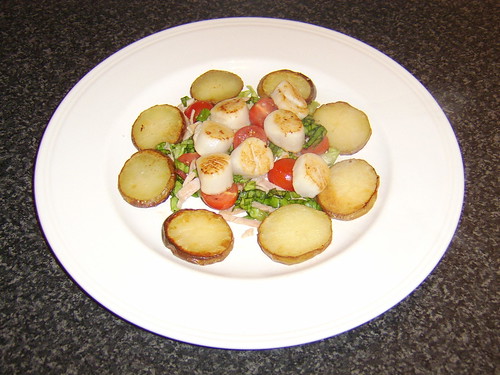
When the frying-pan is virtually smoking hot, the scallops should be added and cooked for thirty seconds each side - no more. They should then be removed from the pan and the meal plated up as shown in the top photograph of this post.

Wednesday, 17 February 2010

Lamb Chilli in Pitta Bread with Salad

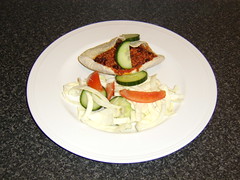
Lamb Chilli in Pitta Bread with SaladCooking with lamb is of course a very different proposition from cooking with beef. The meat is much more tender and when it is minced or ground, finer somehow. This is the principal reason why I have used tomato puree in this recipe for two, rather than the chopped tomatoes I would use in beef chilli. It simply seems more appropriate and less overwhelming.

Ingredients

- Lamb Chilli

1/2lb minced/ground lamb
1 8oz can red kidney beans in water (washed and drained)
1 tbsp tomato puree
1 garlic clove (crushed or grated)
1 red chilli pepper (finely chopped - seeds in or out as preferred)
Salt and freshly ground black pepper

- Salad

1/4 small white cabbage (shredded)
1/2 large onion (finely sliced)
1/2 small cucumber (sliced)
1 large tomato (de-seeded and sliced)

2 pitta breads

Method

The lamb should be carefully browned in a medium to large saucepan for a couple of minutes before the rest of the chilli ingredients are added. A little boiling water may be required in order just to let it simmer gently for around fifteen to twenty minutes. Be careful, however, only to add a little as required, or the chilli will be too watery.

While the chilli is simmering, the salad ingredients should be prepared and added to a large bowl. They should then be seasoned and stirred together thoroughly.

The pitta breads should be sprinkled very lightly with cold water before being placed under a hot grill for one minute each side, once the chilli is ready. A sharp knife should then be used to carefully slit open one side edge of the pitta bread and the chilli carefully spooned inside. Be careful not to overfill, however, or the bread will burst.

I have simply used a little twist of cucumber in the example photographed above for garnish, but such as grated cheese or garlic and herb soured cream are other options which I use from time to time.