Tuesday, 18 May 2010

Chicken Breast Fillet and Bacon Parcels with Roast Potatoes, Tomato and Cucumber

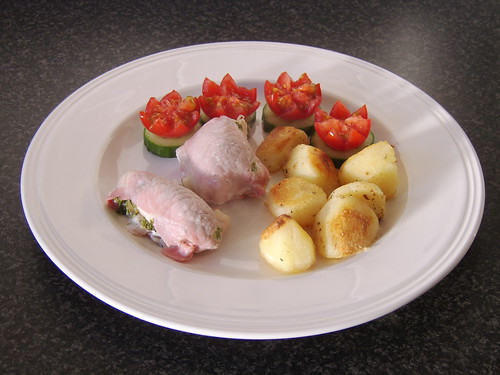
Chicken Breast Wrapped in Bacon with Roast Potatoes and Cucumber and Tomato

These chicken and bacon parcels are a miniature variation of a dish I have prepared for many years. I have served them here with roasted potatoes and an idea that I came up with quite literally on the spur of the moment for an attractive way to present tomato and cucumber. The ingredients for this dish are quoted for two people.

Ingredients

1 chicken breast fillet
8 rashers of bacon
2 large potatoes
4 small tomatoes
8 slices of cucumber (1/4" thick)
1 tbsp freshly chopped coriander (cilantro in USA)
Generous pinch of dried sage
Sunflower oil
Salt and pepper for seasoning

Method

The first step is to put the oven on to preheat to 400F/200C/Gas mark 6. The potatoes should be peeled and chopped in to approximately 1" cubes. They should then be added to a pot of cold water and put on to come to a boil and then simmered for around fifteen minutes.

When the potatoes are on, the chicken breast fillet should be cut in to four strips, lengthwise. Four rashers of bacon should then be laid out flat as shown and a fillet placed on each of them, topped with some coriander. A second rasher of bacon should be added in each instance and the parcels carefully wrapped by tucking the bacon edges underneath. The parcels should then be placed in to a casserole dish - very lightly oiled with sunflower oil - the lid put on and the dish put in to the oven for twenty-five minutes. A further tablespoon of sunflower oil should be added to a baking tray and the tray also added to the oven to preheat.

When the potatoes have been simmering for around fifteen minutes, they should be removed from the heat, drained thoroughly and then returned to the empty pot. Carefully but moderately firmly, the pot should then be shaken to fluff up the edges of the potatoes before they are added to the hot baking tray, carefully swirled in the oil and added to the oven for around ten minutes.

While the chicken and bacon parcels and the potatoes complete their cooking, the core and seeds of the cucumber slices shoud be carefully removed with a sharp paring knife and four slices arranged as shown on each plate. The tomatoes should be halved by carefully cutting in as far as the centre of each tomato around the central circumference at alternate forty-five degree angles. This is surprisingly a lot easier than it may sound or look but great care must be taken to protect your hand holding the tomato in the event of the knife slipping for any untoward reason.

A tomato half should then be placed on top of each slice of cucumber. The casserole dish containing the chicken and bacon parcels may then be removed from the oven and the parcels added, two to each plate. While the potatoes are still on the baking tray, they should be scattered with the sage, seasoned with salt and pepper and given one final, gentle swirl, before being plated up and the meals served immediately.

Friday, 14 May 2010

The FIFA World Cup, 2010 (South Africa) - Special Food Feature Coming Soon!

The FIFA World Cup is the most eagerly anticipated sporting event on Planet Earth. The finals of the tournament take place once every four years, following an approximate two-year qualifying campaign, and last for one calendar month. Thirty-two nations from around the planet, all hoping for the glory of scooping the greatest sporting prize of all, the FIFA World Cup.

So what has the FIFA World Cup got to do with what any of us may intend having for dinner tonight, or indeed any night during the course of the tournament? Won't most people simply sit in front of their TV with some microwaved meal or some takeaway fast food? No doubt many will, but hopefully - with the indispensable assistance of some other food enthusiasts from around the world - I can encourage many of you to make a little bit of extra effort this time around and add a whole new dimension to your enjoyment of the FIFA World Cup.

In simple terms, what I intend to do - for the duration of the tournament - is feature a whole host of dinner suggestions from around the world, representative of one of the countries which happen to be playing a match that particular day. As World Cup tradition dictates that the first match of the tournament always features the host nation playing another country who happen to have been drawn in their group, Friday, 11th June, will feature something representative of South Africa. That was always my intention from the outset.

With regard to Saturday, 12th June, I initially appeared to have hit my first major snag. I am aware that the vast majority of readers of this blog are in either the UK or the USA. Although the UK does not compete as one team in the World Cup, England are featured and not only were England and the USA drawn in the same group (one in eight chance!) but they both play their first match on the same day...against each other! "Which to feature?" was my first thought...

Inspiration fortunately saved me in due course: why not feature both? Particularly as the day in question is a Saturday and a majority of people will have more free time than on a weekday, why not ask an American chef/cook to go up against an English chef/cook in advance of the match itself? Two very different dinner suggestions on the same day: two for the price of one! More details on that one to follow very soon...

I will update in advance on the blog which countries you can find represented on each day, throughout the tournament, as and when I can. I very much hope that whatever happens on the pitches around South Africa, the culinary diversities which we can and will explore here can be appreciated by all who view them.

As for the World Cup itself? At the time of writing, UK Bookmakers, Ladbrokes, make Spain the pre-tournament favourites, followed by Brazil, England, Argentina and Germany, in that order. Interestingly in this respect, no European team has ever won the World Cup when it has been hosted outwith the continent of Europe. Time will of course tell whether that is about to change...

Thursday, 6 May 2010

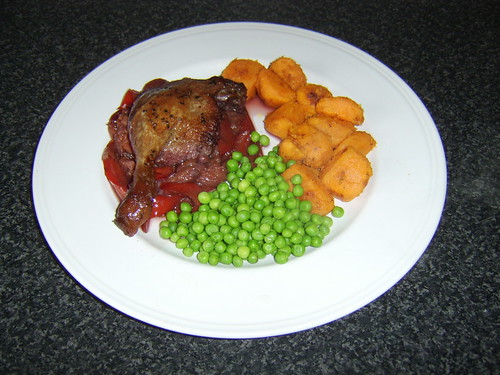
Leg of Duck with Plum and Ginger Sauce and Crispy Sweet Potatoes

Duck Leg with Plum and Ginger Sauce and Crispy Sweet Potatoes

I have come across two popular reasons why people turn up their noses at buying or eating duck legs. I have heard it said that duck legs are as tough as old boots and that duck legs have virtually no meat on them and are therefore not worth their purchase price. In the first instance, the simple answer is that any meat which is not cooked in the correct fashion has the capacity to become as tough as old boots. In the second, we have to ensure when purchasing duck legs - particularly smaller ones - that we are in fact purchasing both the leg and the thigh.

This delicious duck leg recipe is for two people.

Ingredients

2 organic, free range duck legs and thighs
6 ripe plums
1 red bell pepper
1 glass of red wine
1" ginger stem
2 large sweet potatoes
Frozen peas

Method

The oven should be put on to preheat to 350F/180C/Gas mark 4. The skin side of the duck legs should then be pricked several times with a fork and they should be placed, skin side down, in to a dry, non-stick frying pan and brought up to a medium heat. The duck fat will be released through the holes made by the fork and the skin should brown up nicely in the space of around five minutes.

While the duck legs are browning, the plums should be halved and de-stoned, the red bell pepper should be sliced and the seeds discarded and the ginger should be very finely sliced. These items should be added to a large casserole dish and the wine poured on top. The browned duck legs can then be sat on top, skin side facing uppermost, and the frying-pan with the duck fat in it should be set aside for later use. The dish should be covered and placed in to the oven for two and a half hours.

The sweet potatoes should be peeled, chopped and simmered in boiling water for fifteen to twnety minutes, until soft. They should then be drained well before being returned to the pot and shaken around a little to cause the edges to fluff up. The duck fat in the frying-pan should then be brought up to a high heat and the sweet potatoes stirred around in it for just a couple of minutes to crisp up.

The peas should be cooked according to the instructions on the packet and the meal plated up as shown above.