Thursday, 24 June 2010

The Unofficial World Cup of Food 2010 - Japan

It is the turn of Japan to be represented today in the Unofficial World Cup of Food 2010. In the FIFA World Cup in South Africa, the Japanese team take on Denmark tonight with a place in the last sixteen awaiting the winners of that encounter. That could be quite a tasty match as both sides have provided some decent entertainment, with Denmark featuring in what for me has been the most entertaining match of the tournament thus far, against Cameroon last Saturday night.

Before then, however, it is time for a taste of Japanese food. Although most people will automatically think of sushi when Japanese food is mentioned, there is clearly much more to Japanese cuisine. I am delighted to introduce today Helium writer and trainee chef Erikson Arcilla, from the Philippines, who kindly accepted my invitation to feature as a guest representative of Japan.

Shrimp in Tempura Batter

What we have here is a tempura made from beer batter...

Batter:

1/2 can of beer ( your choice )
3/4 cup of flour
1/2 tsp of allspice
1/2 tsp of salt

Directions: Pour the beer in bowl then sift the flour into it. Add in the allspice and the salt and mix it until frothy.

Shrimp:

De-vein the shrimp and put it on a separate plate. Season it with salt and pepper and add olive oil and melted butter (just enough to coat it.)

Add finely chopped rosemary or any herb of your choice. Mix and coat well.

Cooking the tempura:

In a separate bowl. Put in flour. Coat the shrimp before dredging it in the batter.

Heat the oil until it reaches tempura frying range. To test for the right temperature, place a drop of batter into the oil. The batter should rise after 1 or 2 seconds. That is the right time. Cook until golden brown.

Dip:

The dip here is real simple. You can make it by using 1 tbsp. Mayonnaise, 1/2 tsp of oyster sauce, 1/2 tsp of mustard and lime for acidity.

Tuesday, 22 June 2010

The Unofficial World Cup of Food 2010 - Greece

The group stage of the FIFA World Cup 2010 begins to conclude today and for the next four days, four teams each day will be eliminated from the tournament and make the journey home in disappointment. I am happy to say, however, that this does not apply to the Unofficial World Cup of Food 2010 and we are going to be here for what is nearly the three full weeks which remain of the tournament. Today on the Unofficial World Cup of Food 2010 it is the turn of Greece to feature and Helium.com's Internet Channel Manager, Rena Sandou, favours us with a traditional dish from her native land.

Mediterranean food as a whole is of course renowned for its fresh, healthy properties and attractive, colourful presentation. This Souvlaki with Pita Bread which Rena has devised for us is a perfect example of such fine cuisine.

As Greece prepares for what is a huge challenge tonight in that they are required to defeat the might of Argentina to progress in the FIFA World Cup, her players are likely to require every bit of nourishment and goodness their national cuisine can provide...

Souvlaki with Pita Bread

Greeks have a unique, Greek way, of celebrating big sporting events! And Mundial is definitely one of them! By combining tasty and colorful ingredients and good Greek mood, we know how to live the special moments of the national football team and enjoy traditional flavors!

Souvlaki with pitta is a famous, traditional dish, highly appreciated by millions of tourists that visit Greece during summer season each year. There is no doubt that Greek cuisine is ranked among the best in the world and souvlaki has become one of most famous words around the globe!

If you don’t have the chance to visit Greece and taste souvlaki in a traditional taverna on a beautiful Greek island, while enjoying the view of crystal clear waters and pure white scenery, you can always taste souvlaki at home.

Here are the simple steps on how to prepare souvlaki at home (wherever that is!):

Ingredients

* 2lb pork cut in 1 inch cubes
* 2-3 potatoes
* 2 tomatoes
* 2 onions
* 6 pita bread
* Mustard, ketchup and/or tzatziki
* Salt and pepper to taste
* 1 teaspoon dried oregano
* 1/4 cup olive oil
* Lemon juice
* 6 wooden skewers


Preparation

- In a large bowl, mix together pork, olive oil, oregano, lemon juice, salt and pepper. Stir until all ingredients, blend together. Cover and refrigerate for 4 hours.

- Remove meat from the refrigerator at least 45 minutes before cooking. Put 5-6 pork cubes in a wooden skewer. Do the same with the rest skewers until there is no meat left.

- Cook over a barbeque, gas or oven grill. Turn souvlaki regularly for even cooking. Keep in mind that pork meat is tender and does not require too much cooking time; 10-15 minutes will be enough!

- While cooking meat, put pita breads on the grill rank and cook until they become crunchy. Pita breads need only a couple of minutes!

- In the meantime, cook french fries to add them later in your souvlaki.

- When all souvlaki are cooked, place them on a cutting board and sprinkle with salt, pepper, oregano and lemon juice. This is not a required step and it is all up to personal taste!

- Take a pita bread and put the skewer in the middle of it. Fold it, hold the pita tightly and remove the skewer from the meat. Add mustard and ketchup (if you wish), tzatziki, french fries, tomatoes cut in slices and onions.

Serve with a cold glass of beer and enjoy! Bon appetit!

Friday, 18 June 2010

The Unofficial World Cup of Food 2010 - Australia

Good morning, Australia!

It is the very early hours of Saturday, 19th June, 2010, here in Great Britain but I am aware that it is late morning in Australia and that this is the dawn of what is likely to be Australia's big make or break day in terms of the FIFA World Cup 2010 when they take on Ghana. Regardless of what happens on the pitch some hours from now, this is Australia's day in the Unofficial World Cup of Food 2010 and it is therefore my great pleasure to introduce you to Melbourne's Susanna Duffy.

Susanna told me that she rejected the kangaroo and crocodile options for her dish in order to make it more accessible to people the world over and I hope that you appreciate what she has come up with today.

Zucchini Pie

In Melbourne, football is not football without a pie. Now here's a pie with zing - using zucchini. Eaten hot or cold, as a side dish or as a main meal, it's deliciously different whichever way you choose.

Preparation - 20 minutes. : Cooking time - 40 minutes : Eating time - 3 minutes

Ingredients

500g - 1lb zucchini (courgette in UK)
4-5 bacon rashers
1 medium - large onion
110g - US 1/2 cup self-raising flour
4 good sized eggs
1 large cup of vintage or tasty cheddar
80mll - US 1/4 cup vegetable oil
salt & pepper

Method

Firstly, remove the rind from the bacon and chop the meat into small pieces. Peel and chop the onion. Put the bacon and onion into a heavy-based nonstick pan and fry over a medium to high heat for approximately 5 minutes. The onion needs to be softened, not browned. Set aside to cool.


Wash the zucchini, slice off the ends and finely grate the rest. After you've grated them all, squeeze over the sink to get rid of excess liquid.

Mix the grated zucchini mixture, the cooled onion and bacon, the cheese and flour in a large bowl.

Break the eggs into a separate bowl, add the oil and stir to combine.

Pour the egg mixture into the large bowl of zucchini mix. Stir them thoroughly together. Add some salt and pepper to taste.

Pour this combined mixture into a slice pan, lamington pan or baking dish. Spread it out evenly.


Bake this combination in a moderate oven for about 40 to 45 minutes. Check with a skewer to make sure it's cooked through.

When it's cooked through, take it out of the oven and let it set for about 10 minutes.


The pie is thereafter ready to be sliced and served.

Thursday, 17 June 2010

The Unofficial World Cup of Food 2010 - Mexico

Tonight sees Mexico play their second match of the FIFA World Cup 2010. Following their opening day draw with the hosts, South Africa, they find themselves coming up against the beaten finalists of 2006, France. In the wake of Uruguay's convincing victory over South Africa yesterday, defeat for either side tonight could have very serious repercussions. Purely as a useless piece of trivia, this is a repeat of the first ever match to be played in a World Cup Finals, back in 1930 in Montevideo, Uruguay. Mexicans everywhere will be hoping that a repeat of the 4-1 French victory on that occasion can most certainly be avoided...

On what is a very big day for Mexico, therefore, it is my great pleasure to introduce you to Colene Pefley, a friend of mine and fellow Helium writer, who is doing something which thus far only I myself have done in this project: guest featuring for a country other then her own. Colene is from Southern California, in the USA.

Enchiladas Verde

Green Enchilada Sauce

1 lb. tomatillos (green husk tomatoes)
1-2 serrano peppers (milder than jalapeƱos)
1/2 cup white onion, diced
1/4 cup chicken broth
Salt to taste

Boil tomatillos and serrano peppers for 7-10 minutes until tomatillos darken in color and prick easily with a fork. Drain tomatillos and peppers and transfer to blender. Add chicken broth and blend. Mix in onion and salt.


Enchiladas Verde

Serves 4

2 boneless skinless chicken breasts, cooked and shredded
1/2 cup onions, diced
2 tsp. minced garlic
1/2 cup shredded cheddar cheese (for filling)
Enchilada sauce
6 corn tortillas
1/2 cup shredded cheddar cheese (for topping)

Preheat oven to 350 degrees Fahrenheit. In a small skillet over med-high heat, saute onions and garlic for approximately 3 minutes or until onions are translucent. Remove from heat. In another skillet heat corn tortillas, one at a time, over medium heat, until warm. In each tortilla spoon an even mixture of chicken, onions and garlic, shredded cheese, and a small amount of sauce. Roll shut and place closed side down into a 13 x 9 baking dish that has been lined with a thin layer of sauce. Pour remaining enchilada sauce over enchiladas, covering them completely. Bake for 20 minutes or until sauce bubbles. Sprinkle 1/2 cup cheese on top of enchiladas and bake for 5 more minutes or until cheese is melted. Serve with rice and refried beans.

Monday, 14 June 2010

The Unofficial World Cup of Food 2010 - Denmark

It has not been easy for me to establish any real ancestral connection with any of the countries involved in the FIFA World Cup 2010 to an extent which truly justifies my representing them in this event. Although I am of course aware that no such justification is necessary and I will maybe dabble as a guest here and there as the tournament progresses, I wanted to represent one country with which I can at least appear to establish some form of tentative bond.

In common with most of the other inhabitants of the UK, my heritage will of course be mixed with particularly the Normans and the Saxons of Mainland Western Europe at some stage in the distant past. The most obvious connection which I can claim to a country participating in the FIFA World Cup 2010, however, is that my maternal grandmother's family name was Haldane. There is much debate as to the origins of the name Haldane in Scotland, with some advancing the theory that it was of Norman introduction in the 12th Century, as opposed to earlier Danish introduction. At least for the purposes of this event, however, I am coming down firmly on the side of the more obvious Danish theory and taking the opportunity to guest today as a cook for the country of Denmark.

When most people in the English speaking world hear the words, "Danish," and, "Food," it is probably safe to say that a great many will immediately think of sweet pastries or bacon. There is naturally, however, a great deal more to Danish food than pastries or bacon, as I have found in researching this article. The climate and geography of Denmark means that hardy grains and vegetables form a large part of the Danish diet, as does fresh fish. I had several ideas pencilled in for this project but as soon as I came across Bagte Fiskefilet, I knew beyond doubt what I was cooking.

Bagte Fiskefilet translates at least loosely in to English as, "Baked Fillet of Sole." The fillets are baked in the oven with butter, before being served with a sauce made of butter, lemon juice and prawns/shrimp. I have taken the liberty of using an unfilleted lemon sole here - purely for greater substance in the presented dish - and adding a little parsley to the sauce for colour.

Ingredients (Per Person)

1 lemon sole (gutted - head and tail removed)
2oz butter
2 tsp of roughly chopped prawns/shrimp (pre-cooked)
1 tsp fresh lemon juice
1 tsp freshly chopped parsley
Salt and freshly ground black pepper

Method

I have served this dish with some boiled new potatoes in butter. If you choose to do likewise, the first step will be to get your potatoes on to boil.

Preheat your oven to 400F/200C/Gas Mark 6. Spread a large sheet of aluminium foil on a baking tray and place the lemon sole on it, dark-skinned side uppermost. Make three diagonal cuts across the top of the fish. Use 1 oz of the butter to place a little in each slit and the remainder in the cavity of the fish. Season lightly with salt and pepper and carefully wrap up the fish to form a sealed but loose package. Place it in to the oven and cook for fifteen minutes.

As the sauce takes less than a minute to prepare, wait until the fish is ready and remove it from the oven. Put the butter and lemon juice in to a small saucepan and on to as low a heat as possible while you carefully unwrap the fish - due to escaping steam - and transfer it to the plate. When the butter is almost melted, add the parsley and shrimp/prawns and season with black pepper only. Stir with a wooden spoon to simply heat the shellfish through before carefully spooning the sauce over the fish and serving.

This dish was incredibly easy to make and being such a lover of fresh fish as I am, I was in no doubt that I would enjoy it but I can honestly say that it was even more delicious than I had anticipated and I very much hope you will try it out for yourself at home.

(Note that serving it with Denmark's most famous liquid export is wholly optional!)

Sunday, 13 June 2010

The Unofficial World Cup of Food 2010 - Germany

Today sees the Unofficial World Cup of Food 2010 assume what will be its more usual format, featuring one country and one food writer per day. Tonight, Germany open their World Cup campaign in South Africa when they take on Australia and it is my great pleasure today to introduce you to Chef Keem, a native German now resident in the United States.

Germany of course received a huge blow in advance of the World Cup when their inspirational skipper, Michael Ballack, sustained an injury playing in the English FA Cup Final, which ruled him out of the tournament. How that will affect Germany's chances in South Africa, only time will tell but I am happy to confirm that no such issues have affected Chef Keem in the kitchen.

Cooking for Germany: Chef Keem

Consider this German Beef Rouladen recipe a consolation prize for all the poor teams that have lost against Germany in the 2010 Soccer World Cup. Since I'm writing this on May 18, I might end up falling on my face with this mouthful of braggadocio, eh? Well, in case things don't work out as I hope (and Germany doesn't win the title), at least I have something really good to fill my mouth with on July 11.

How To Make German Beef Rouladen Worthy of A Culinary World Cup

1. Tenderize an 8 to 10-ounces slice of beef (inside round or top round), but don't overdo it so the meat rips apart. Season well with salt and pepper.

2. Now spread the following ingredients over the meat: 1 Tblsp thinly-sliced smoked bacon, 1 Tblsp chopped onions, 1 tsp minced garlic, 1 Tblsp mustard (any kind), and 1 pickle spear. (In the video, the first 4 ingredients are already mixed together.)

3. Make a tight roll and secure the end with 2 tooth picks.

4. Brown the rouladen from all sides in hot oil; remove from pot into a bowl.

5. Cook a handful of chopped onion and one or two teaspoons of minced garlic until translucent and lightly browned; add one bay leaf.

6. Pour 1-2 cups of red wine into the pot and loosen the brown bottom bits with a spatula while boiling the liquid for 3-4 minutes.

7. Put the rouladen back into the pot and barely cover them with good beef stock (broth).

8. Bring everything to a gentle simmer, cover the pot, and cook for about an hour.

9. Remove the beef rolls to a covered dish and keep warm.

10. Whisk a 1/2 cup of sour cream and some cold thickener (roux) into the liquid to add body and flavor to the sauce; cook on high until lightly thickened.

11. Don’t forget to remove the tooth picks before serving the rouladen covered with sauce.

12. Great side dishes include mashers, pasta, rice, potato dumplings, bread dumplings, carrots, green beans, red cabbage or sauerkraut.

OK, I'll try to be impartial and generous: May the best team win the 2010 Soccer World Cup! (Which is what's going to happen, anyway.)

Update!! - Sunday Evening (UK time)

I promised Chef Keem earlier this week that I would enjoy a Weissbier or two as I watched the game tonight. I did not forget, Chef! I poured this Erdinger beer only minutes ago and am savouring it as I watch the match, where Germany currently lead Australia 2-0 at half-time.

For those who are unfamiliar with Weissbier, it translates in to English as, "Wheat beer." The word weiss in German can mean either, "White," or, "Wheat." I drank quite a few of these while in Germany for the FIFA World Cup 2006! To be enjoyed at its best, Weissbier really has to be poured in to a proper Weissbier glass as this one is and which I was given as a gift in Munich a number of years ago.

Thursday, 10 June 2010

The Unofficial World Cup of Food 2010 - England v USA

After all the build up, all the talking, all the hype and all the bravado, the FIFA World Cup 2010 is now upon us. It is time for the players and the coaches who are in South Africa as you read this to put up, or shut up. On Sunday, 11th July, 2010, one of thirty-two national captains will lift the biggest prize in sport: the FIFA World Cup.

It is to food, pleasure and partying, however, that the Unofficial World Cup of Food 2010 is dedicated. Whatever takes place on the pitch is beyond our control. It is now my greatest pleasure to introduce you to those who represent their countries on the first contributary day of The Unofficial World Cup of Food 2010 and I hope very much that you will take the time to view the efforts of both ladies, from whichever side of the Atlantic divide you happen to originate. They have both put in considerable effort, for which I am eternally grateful. If you like what the ladies have shared with you, please take the time to let them know via the links provided to their own websites. If - for whichever unimaginable reason, you don't - you can contact me via the comments option at the bottom of this post. The fault will undoubtedly be a technical one on my part...

Ladies and gentlemen, it is my great pleasure to introduce to you, Marie Rayner and The Thrillbilly Gourmet, cooking for England and the United States of America, respectively. The order in which they are featured is simply that by which FIFA have billed the match.

Cooking for England: Marie Rayner

When Gordon asked me to participate in this fabulous cookery event , being held in association with the World Cup, I was quite chuffed to say the least!! The World Cup is one of the most popular set of football matches here in England, and with it being held in South Africa this time around, that makes it even more special. The whole neighbourhood where I live is one huge testimony to the loyalty of England football fans, with every house being festooned with England Flags and bric a brac! Although I am originally from Canada, I am just as up for this big match as anyone else. I absolutely love this adopted country of mine, and it’s people . . . and I especially love the food here. I put a lot of thought into this dish which I think represents some of the best of what England has to offer in both food and tradition. This is what I aim to achieve each day on my own page, The English Kitchen, where I am debunking the myths of English Cookery, one recipe at a time. This dish is a wonderful meat fest of gargantuan proportions . . . salt marsh lamb (if you can get it), meaty pork sausages, bacon chops and beautiful British rump steaks . . . all grilled to perfection and placed inside individual plate sized traditional Yorkshire puddings, with a tasty garnish of grilled tomatoes and mushrooms. With true English Roasties on the side as well as some tasty cabbage, leeks and peas, this is a dish fit for a king, or at least a group of hungry Footie fans! Go England!!

*Pundit Pudding*
Serves 4

The best of England, served up in your very own Yorkshire pudding bowl! Do plan ahead as the batter for the puddings needs to sit out for an hour at room temperature before baking!

4 Lamb chops, trimmed
4 Small rump Steaks
4 small bacon chops
4 thick and meaty Butcher’s pork and leek sausages
Butter, melted
Salt and fresh ground black pepper
2 Large Tomatoes
4 Large Mushrooms
For the Pudding:
2 large free range eggs, at room temperature
1 tsp salt
1/2 pint milk, at room temperature (1 1/3 cup)
140g plain flour (1 cup)
a little oil or dripping


Make sure all your ingredients for the pudding are at room temperature before beginning. Beat your eggs together in a large measuring jug until very light. Whisk in the milk. Sift the flour into a bowl along with the salt. Make a well in the middle and add the wet ingredients all at once, pouring them into the well, and then whisk them in, slowly incorporating the dry mixture from the sides until you have a smooth batter. Now, this is the important bit . . . COVER IT AND LET IT SIT ON THE SIDEBOARD FOR ONE HOUR.

Preheat your oven to 230*C/450*F. Place a small amount of oil or dripping into each of four medium sized pie tins. (You will want ones with a six inch base) Place the tins on two baking trays and then put them into the hot oven to heat up until the fat is hot and sizzling. Remove from the oven and quickly divide the batter amongst each muffin cup, filling them about 2/3 full. (You may not use it all.) Return to the oven and bake for 20 minutes, until well risen, browned and crispy, reducing the oven temperature by 10 degrees every five minutes.

While your puddings are baking cook your meats. Preheat the grill to it’s hottest. Brush the steaks and chops with some melted butter and sprinkle with some sea salt and freshly ground black pepper

Place the sausages on a rack in a grill pan and grill for about 7 to 8 minutes, turning frequently. Add the lamb chops and the rump steaks. Continue to grill for another 5 to 7 minutes, allowing 3 to 5 minutes per side for medium rare. Remove to a heated plate and keep warm. Now grill the bacon chops, allowing 3 to 5 minutes per side. Remove to the heated plate and keep warm.

Slice the tomatoes in half and brush each half with some melted butter, along with the mushrooms. Place all beneath the grill and grill for about 5 minutes. Remove from the grill and season to taste.
Remove the crisp and fluffy puddings from the oven and tip out of the pie tins. Place each one on a heated plate, right side up. (So that it looks like a bowl) Place inside each: one lamb chop, one sausage, one bacon chop and one piece of rump steak. Garnish each with half a grilled tomato and a grilled mushroom.
Serve immediately with some crisp roasted potatoes and a green vegetable on the side. (I used lightly sautƩed Savoy cabbage and leek mixed with some tender spring peas.)

Bisto Gravy and Brown Sauce are completely optional!


Cooking for the United States of America: The Thrillbilly Gourmet

For the brine -
1 qt of buttermilk, preferably whole milk buttermilk but any will do
cut up chicken - I use packages of legs - 12 at a time, or breasts, or both, even a whole cut up chicken
kosher salt

For the sauce:
1 cup mayonnaise - don't worry about homemade, by the time you've cooked with it, it won't matter
2/3 cups apple cider vinegar
1 Tbl lemon juice
1 tsp salt
4-5 cranks freshly cracked black pepper
cayenne pepper to taste - the mayonnaise cuts the heat a lot, so I use 2 tsp, or even more

1. Mix all ingredients for the sauce well, and refrigerate. I try to do this several hours ahead so the sauce marries and mellows, but even twenty minutes is good. Before you use it, save some for dipping at the table. You'll only need about half for saucing on the grill.
2. Place the chicken in a large container, and cover with buttermilk. Make sure it's submerged, and refrigerate. Up to over night is good, but try for at least four hours.
3. A couple of hours before you barbecue, drain the chicken and place it on a baking sheet or over a rack and allow it to air dry for a while. You don't want to lose the buttermilk, but you do want the chicken skin as dry as possible so it will crisp.
4. Remove the chicken from the fridge while you preheat your grill. Crank it up - high as it will go. You want lots of heat in there.
5. Salt the chicken on all sides well with the kosher salt. Turn the grill to low, or if using charcoal, find the 'cool' spot. For breasts, the total cook time is 30 minutes. For legs and thighs, the time is 20 minutes - with that said the interior temp with the grill lid shut should stay at just over 400F. You also want to turn the chicken so the skin crisps well on all sides.
6. Once the chicken is nearly done - just a few minutes to go - apply the white sauce with a brush. Keep the lid closed as much as possible so that the sauce adheres well in the heat. I usually douse one side, close the lid for 3-4 minutes, flip it over, coat the second side and repeat. The sauce will burn easily, so be careful.
7. Allow the chicken to rest for at least 5 minutes - 10 if you can wait long enough, and you're good!

England v USA - The Football (Soccer) Match

England and the USA have met in the Group Stages of the World Cup before, back in 1950, in Brazil. At that time, England were the favourites to win the trophy and expected to not only beat the USA, but to do so extremely convincingly. Soccer then was probably even less popular in the USA than it is now and the USA were quoted at an incredible 500/1 to win the tournament. The result?

England 0, USA 1

I hope that these two magnificent recipes have inspired you to cook in advance of the match tonight and to enjoy it to the full. Whoever wins on the pitch tonight, there can be little doubt that both of the above recipes are winners and that the Unofficial World Cup of Food has certainly started in style...

The Unofficial World Cup of Food 2010 - Opening Ceremony

The opening ceremony of the FIFA World Cup 2010 is about to take place in Johannesburg, South Africa. It will be attended by dignitaries including the President of the United States, Barack Obama, and will be watched by a global TV audience of more than 500 millions.

Before I get myself comfortable to watch the festivities and the opening match of the World Cup between South Africa and Mexico which will follow, it is time to formally announce the beginning of the Unofficial World Cup of Food 2010. In so doing, I would simply like to spend a little time looking in general at what this blog is going to feature over the course of the next calendar month and how all who visit it can make the most of both World Cups and have as much fun from the procedures - on the pitch and in the kitchen - as possible.

The FIFA World Cup is often thought of simply as a sports' tournament. In truth, however, it is much, much more: it is mostly about the football, yes; but it is also about a coming together and celebration of different peoples and cultures. I was privileged to attend the FIFA World Cup 2006 in Germany and even although I very often did not understand the nature of the celebrations of the different peoples - never mind their language - it was wonderful to sample the friendly atmosphere generated by so many different nationalities coming together in one place for the purpose of enjoying themselves as much as possible.

Starting tomorrow, Saturday 12th June, it will be my great pleasure to introduce a number of cooks and food writers from around the world, who will during the course of the tournament share with all who visit this blog their culinary talents and creations. I will include this feature three or four times each week, for the duration of the tournament. I also have a number of other ideas which I hope to incorporate, all geared towards enjoying this magnificent global celebration period to the full.

So how can you get in to the spirit of the World Cup? How can you use the occasion to sample different cultures and cuisines, broaden your knowledge and have a great deal of fun at the same time?

As stated above, there will be a number of dishes shared here which you can have a go at making at home. Why not, however, host your own World Cup Party and come up with your own, innovative creations? You may well choose to host such an event when your own country is playing in a match and have the food and drink as you cheer your team on - that will no doubt be by far the most popular option. Why not, however, broaden your horizons and branch out in to the unknown...?

A few nights ago, I decided to cook a dish for one of the lesser known countries in a culinary sense which are participating in the FIFA World Cup. I picked a number of candidate countries and drew one at random - Ghana. I then simply searched Google for Ghanaian recipes for which I could obtain the principal ingredients and cooked a disk called Shoko, which is a beef and spinach stew. It was delicious!

Why not therefore look at the fixtures for the FIFA World Cup and select a match which is taking place on a night convenient for hosting your party, which features two countries with which you are unfamiliar with their national cuisine? Google is a wonderful tool in this respect and you may be surprised what tasty recipes you can find simply by searching the name of the country along with the words, "Food," or, "Recipes." There is no need to prepare anything complicated - you may simply wish to prepare a buffet style meal, which can be enjoyed by all as you watch the match.

What is a party, of course, without a drink? Even if you do not wish to incorporate alcoholic drinks, a lot of fun can be had preparing non-alcoholic fruit cocktails. I am one of those people who does enjoy a beer watching the match, however, so I spent some time last night browsing the beer aisle of my local supermarket, looking for unusual brews.

I found a great many candidates from around the world which I will sample as time goes on but for the opening night of the tournament, I could not resist the quaintly named English Ale, "Piddle in the Hole." The beer is produced by the Wyre Piddle Brewery and I will share with you at a later time what I thought of the brew.

Finally, today, I would wish you all a fun-filled time for the duration of the World Cup and although only one nation can be happy at the end of the FIFA event, I hope that people across the globe can get involved in and enjoy the Unofficial World Cup of Food 2010 to the full.

Tuesday, 8 June 2010

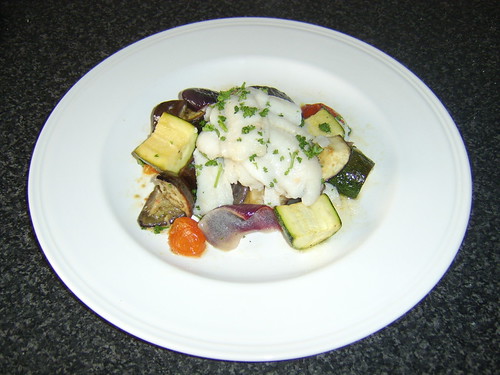
Lemon Sole on Oven Roasted Seasonal Mediterranean Vegetables

Lemon Sole on Roasted Mediterranean Vegetables

With Summer now officially upon us and the rain lashing my window as I type these words scheduled - in theory at least - to grow a little warmer, I decided to feature something reminiscent of more desirable climes and happier times spent languishing in the warmth of the Mediterranean sun. This incredibly simple way of roasting seasonal Mediterranean vegetables in the oven and cooking the lemon sole on top is described in quantities which should serve two people.

Ingredients

3/4lb skinless lemon sole fillets
1 aubergine (known as eggplant in the USA)
1 courgette (known as zucchini in the USA)
1 large red onion
12 small cherry tomatoes
2 cloves of garlic
Salt and pepper
Olive oil
Chopped parsley for garnish

Method

Place Lemon Sole atop Partially Roasted VegetablesThe oven should be put on to preheat to 400F/200C/Gas Mark 6 while the vegetables are being prepared.

The courgette (zucchini) and aubergine (eggplant) should be chopped in to approximately 1" pieces. The red onion should be peeled and quartered down through the centre. The pieces will separate naturally during cooking but this can be done by hand beforehand if desired. The garlic should be finely chopped and a small cut made in the top of each tomato to stop them from bursting and potentially making a mess of the oven.

The vegetables should be mixed together in a deep baking tray and seasoned well with salt and freshly ground black pepper. Olive oil should be drizzled fairly liberally over the top.

The vegetables should be placed in to the oven and roasted for half an hour. At which point, the fish strips should carefully be placed on top and the dish cooked for a further ten minutes only.

The delicious roasted Mediterranean vegetables and delicate lemon sole may then be carefully transferred to plates and served.

Friday, 4 June 2010

The Unofficial World Cup of Food 2010 - Update

It is precisely one week today that the biggest sporting event of all, the FIFA World Cup, kicks off in its nominated destination for 2010, South Africa. This is the first time that the four-yearly tournament has ever been held on the African continent and it is likely to prove to be something special, for that fact alone.

As advised a couple of weeks back, I have decided to invite and engage the assistance of a number of food writers from around the world to showcase their talents on this blog during the month long tournament, preparing a dish representative of their respective countries, on a date upon which their country is actually playing a match. I have labelled this project, "The Unofficial World Cup of Food 2010." I hope that you will pay a return visit to see some of the dishes prepared in relation to this project and meet some of those people who will be creating them. With this in mind, below is a short guide to some of the writers who will be featured in the first week (approximately) of the tournament and the countries they will be representing... I have to keep some things back as a surprise!

Saturday, 12th June

This one day had to be a special one, for the reason that England and the USA open their campaigns against each other. As the majority of readers of this blog are in one of those two countries, I decided to feature both!

Cooking for England will be Marie Rayner and for the USA, The Thrillbilly Gourmet (aka DixieMockingbird).

Sunday, 13th June

Representing Germany will be Chef Keem, sharing with us some Bavarian delights, which I personally love so much.

Thursday, 17th June

Colene Pefley from the USA has kindly agreed to, "Guest," feature on behalf of Mexico, a country of which she has substantial knowledge of the food and culture.

Saturday, 19th June

This day will see Susanna Duffy cook for Australia, as her country goes up against Ghana on the field of play.

The 2010 World Cup is likely to be a very different spectacle for me personally from the 2006 tournament in Germany. At this stage of the lead-up four years ago, I was counting down the hours until a couple of friends and I flew out to Munich to take in the first couple of weeks of the event. Unfortunately, only two of us actually made it out there but we set off with high hopes of actually getting match tickets, ideally for the Brazil v Australia game which was taking place in the city during the period of our stay. We were offered two tickets on the underground market - at a cost of US$2,000 each! Needless to say, we watched the match on TV in one of the city's biergartens...

It was my first taste of the true atmosphere of the World Cup and the multi-national, multi-cultural spirit which it incorporates. I will never forget until the day I die being one of two Scots sitting in the huge Michaelibad Biergarten in Eastern Munich on a beautiful, scorching hot day as Germany prepared to play a match. I think that we were the only two foreigners in the place and the roar as untold thousands of Germans rose for and sang, "Deutschland Uber Alles", certainly made the hairs stand up on the backs of our necks. It was a fantastic spectacle, however, and an incredible experience.

What will follow on this blog over the next few weeks is my humble attempt to bring some of that variety, entertainment and multi-culturalism to food. I hope that all who follow it are in some way at least educated and entertained.

The tournament itself? UK bookmakers Ladbrokes still make Spain the favourites to lift the trophy, followed by Brazil, Argentina, England and Holland, in that order. Time will of course tell...

Tuesday, 18 May 2010

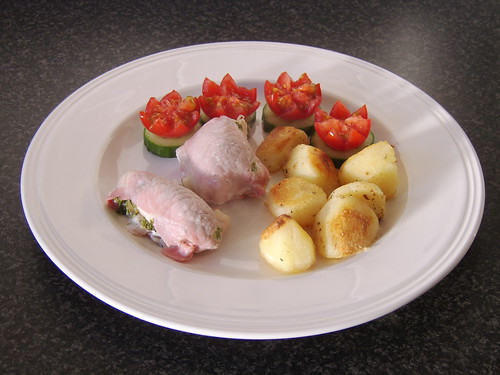
Chicken Breast Fillet and Bacon Parcels with Roast Potatoes, Tomato and Cucumber

Chicken Breast Wrapped in Bacon with Roast Potatoes and Cucumber and Tomato

These chicken and bacon parcels are a miniature variation of a dish I have prepared for many years. I have served them here with roasted potatoes and an idea that I came up with quite literally on the spur of the moment for an attractive way to present tomato and cucumber. The ingredients for this dish are quoted for two people.

Ingredients

1 chicken breast fillet
8 rashers of bacon
2 large potatoes
4 small tomatoes
8 slices of cucumber (1/4" thick)
1 tbsp freshly chopped coriander (cilantro in USA)
Generous pinch of dried sage
Sunflower oil
Salt and pepper for seasoning

Method

The first step is to put the oven on to preheat to 400F/200C/Gas mark 6. The potatoes should be peeled and chopped in to approximately 1" cubes. They should then be added to a pot of cold water and put on to come to a boil and then simmered for around fifteen minutes.

When the potatoes are on, the chicken breast fillet should be cut in to four strips, lengthwise. Four rashers of bacon should then be laid out flat as shown and a fillet placed on each of them, topped with some coriander. A second rasher of bacon should be added in each instance and the parcels carefully wrapped by tucking the bacon edges underneath. The parcels should then be placed in to a casserole dish - very lightly oiled with sunflower oil - the lid put on and the dish put in to the oven for twenty-five minutes. A further tablespoon of sunflower oil should be added to a baking tray and the tray also added to the oven to preheat.

When the potatoes have been simmering for around fifteen minutes, they should be removed from the heat, drained thoroughly and then returned to the empty pot. Carefully but moderately firmly, the pot should then be shaken to fluff up the edges of the potatoes before they are added to the hot baking tray, carefully swirled in the oil and added to the oven for around ten minutes.

While the chicken and bacon parcels and the potatoes complete their cooking, the core and seeds of the cucumber slices shoud be carefully removed with a sharp paring knife and four slices arranged as shown on each plate. The tomatoes should be halved by carefully cutting in as far as the centre of each tomato around the central circumference at alternate forty-five degree angles. This is surprisingly a lot easier than it may sound or look but great care must be taken to protect your hand holding the tomato in the event of the knife slipping for any untoward reason.

A tomato half should then be placed on top of each slice of cucumber. The casserole dish containing the chicken and bacon parcels may then be removed from the oven and the parcels added, two to each plate. While the potatoes are still on the baking tray, they should be scattered with the sage, seasoned with salt and pepper and given one final, gentle swirl, before being plated up and the meals served immediately.

Friday, 14 May 2010

The FIFA World Cup, 2010 (South Africa) - Special Food Feature Coming Soon!

The FIFA World Cup is the most eagerly anticipated sporting event on Planet Earth. The finals of the tournament take place once every four years, following an approximate two-year qualifying campaign, and last for one calendar month. Thirty-two nations from around the planet, all hoping for the glory of scooping the greatest sporting prize of all, the FIFA World Cup.

So what has the FIFA World Cup got to do with what any of us may intend having for dinner tonight, or indeed any night during the course of the tournament? Won't most people simply sit in front of their TV with some microwaved meal or some takeaway fast food? No doubt many will, but hopefully - with the indispensable assistance of some other food enthusiasts from around the world - I can encourage many of you to make a little bit of extra effort this time around and add a whole new dimension to your enjoyment of the FIFA World Cup.

In simple terms, what I intend to do - for the duration of the tournament - is feature a whole host of dinner suggestions from around the world, representative of one of the countries which happen to be playing a match that particular day. As World Cup tradition dictates that the first match of the tournament always features the host nation playing another country who happen to have been drawn in their group, Friday, 11th June, will feature something representative of South Africa. That was always my intention from the outset.

With regard to Saturday, 12th June, I initially appeared to have hit my first major snag. I am aware that the vast majority of readers of this blog are in either the UK or the USA. Although the UK does not compete as one team in the World Cup, England are featured and not only were England and the USA drawn in the same group (one in eight chance!) but they both play their first match on the same day...against each other! "Which to feature?" was my first thought...

Inspiration fortunately saved me in due course: why not feature both? Particularly as the day in question is a Saturday and a majority of people will have more free time than on a weekday, why not ask an American chef/cook to go up against an English chef/cook in advance of the match itself? Two very different dinner suggestions on the same day: two for the price of one! More details on that one to follow very soon...

I will update in advance on the blog which countries you can find represented on each day, throughout the tournament, as and when I can. I very much hope that whatever happens on the pitches around South Africa, the culinary diversities which we can and will explore here can be appreciated by all who view them.

As for the World Cup itself? At the time of writing, UK Bookmakers, Ladbrokes, make Spain the pre-tournament favourites, followed by Brazil, England, Argentina and Germany, in that order. Interestingly in this respect, no European team has ever won the World Cup when it has been hosted outwith the continent of Europe. Time will of course tell whether that is about to change...

Thursday, 6 May 2010

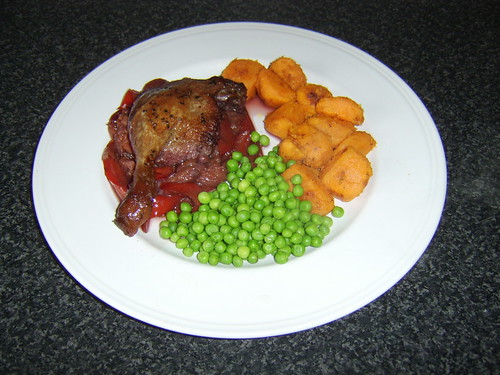
Leg of Duck with Plum and Ginger Sauce and Crispy Sweet Potatoes

Duck Leg with Plum and Ginger Sauce and Crispy Sweet Potatoes

I have come across two popular reasons why people turn up their noses at buying or eating duck legs. I have heard it said that duck legs are as tough as old boots and that duck legs have virtually no meat on them and are therefore not worth their purchase price. In the first instance, the simple answer is that any meat which is not cooked in the correct fashion has the capacity to become as tough as old boots. In the second, we have to ensure when purchasing duck legs - particularly smaller ones - that we are in fact purchasing both the leg and the thigh.

This delicious duck leg recipe is for two people.

Ingredients

2 organic, free range duck legs and thighs
6 ripe plums
1 red bell pepper
1 glass of red wine
1" ginger stem
2 large sweet potatoes
Frozen peas

Method

The oven should be put on to preheat to 350F/180C/Gas mark 4. The skin side of the duck legs should then be pricked several times with a fork and they should be placed, skin side down, in to a dry, non-stick frying pan and brought up to a medium heat. The duck fat will be released through the holes made by the fork and the skin should brown up nicely in the space of around five minutes.

While the duck legs are browning, the plums should be halved and de-stoned, the red bell pepper should be sliced and the seeds discarded and the ginger should be very finely sliced. These items should be added to a large casserole dish and the wine poured on top. The browned duck legs can then be sat on top, skin side facing uppermost, and the frying-pan with the duck fat in it should be set aside for later use. The dish should be covered and placed in to the oven for two and a half hours.

The sweet potatoes should be peeled, chopped and simmered in boiling water for fifteen to twnety minutes, until soft. They should then be drained well before being returned to the pot and shaken around a little to cause the edges to fluff up. The duck fat in the frying-pan should then be brought up to a high heat and the sweet potatoes stirred around in it for just a couple of minutes to crisp up.

The peas should be cooked according to the instructions on the packet and the meal plated up as shown above.

Thursday, 29 April 2010

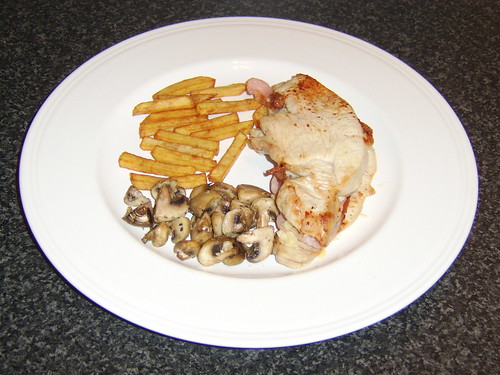
A Grilled Turkey Sandwich and Fries - My Alternative to the KFC Chicken Double Down

Grilled Turkey Sandwich and Fries

I have to admit that all I know about the KFC Chicken Double Down is that which I have read in the online press. That is more than for any other reason that, to the best of my knowledge, the nearest KFC to where I am presently living is the one outside Glasgow Central Station and that would make it a very long journey just to sample some fast food! I must admit to having been surprised by the publicity generated simply by the launch of a fast food product but it at least gave me the idea for this grilled turkey sandwich, with homemade fries and garlic mushrooms. I decided to make it a turkey recipe as opposed to a chicken recipe, simply to make it a little bit different to most similar productions.

Ingredients (Per Person)

2 x 1/2lb turkey breast fillets
2 rashers of bacon
2oz low fat cheddar cheese (or other suitable hard cheese)
1 large potato
6 to 8 small button mushrooms
1 clove of garlic
Pinch of dried sage
1 tbsp extra virgin olive oil
A little sunflower oil

Method

The first step in this recipe is to attend to the fries. The potato should be peeled, then sliced and chopped in to the shape of fries. Very importantly, the fries should then be dried as much as possible in kitchen towel before being submerged in the fryer for around four minutes, until they show only the first signs of beginning to colour. They should then be removed from the fryer, drained on some more fresh kitchen towel and allowed to cool before being placed in a Tupperware container and refrigerated for at least half an hour.

I cooked the turkey breast fillets here on an indoor, standard kitchen grill. They would probably at least look better cooked on an outdoor grill but that is not always practical in Scotland in April! They should be lightly rubbed with sunflower oil on both sides and grilled for around four to five minutes each side, depending on their thickness. The bacon should be added to be grill for around a minute each side towards the end of the cooking time.

When the bacon has been added to the grill, the cold fries should be re-added to the fryer for their last two to three minutes of cooking time. The olive oil should then be added to a small saucepan and brought up to a medium heat before the peeled garlic clove is grated in to it and the sage also added. The closed cup mushrooms should be quartered and also added put in to the pan. Note that the mushrooms should be cooked for no more than a couple of minutes, as the idea is more to heat them through and flavour them with the oil and garlic than cook them in to mush.

Assembling a Grilled Turkey Sandwich

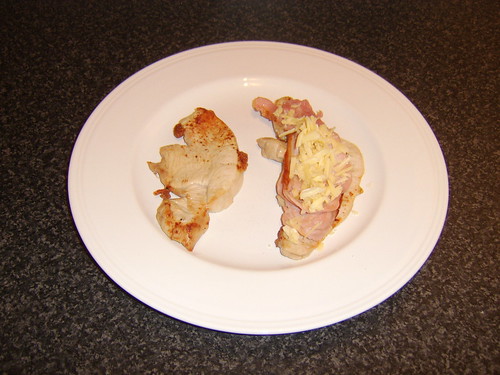
When the turkey and bacon fillets and rashers are ready, they should be taken from the grill and the bacon rashers placed atop one of the turkey fillets. The cheese should then be grated and added on top of the bacon before the second turkey fillet is finally placed on as the top of the sandwich. The fries should then be well drained and added to the plate along with the garlic mushrooms for service.

Sunday, 11 April 2010

Polish Kielbasa with Caramelized Onions, Sauerkraut and Crispy Potato Pancakes

Today's post on, "What Should I Have for Dinner Tonight?" is the latest guest post. It is my pleasure to introduce a meal prepared for us by Mary Bishop - who writes very successfully for Helium.com under the pseudonym, Tierney O'Hara. Mary (Tierney) has not only prepared this meal for us but even gone to the bother of preparing settings and drinks accompaniment suggestions.

Without further ado, I will hand over to Mary - in whose own words this wonderful and delicious recipe appears...

Polish Kielbasa with Caramelized Onions, Sauerkraut and Crispy Potato Pancakes

It's late and I'm tired and hungry. I want something that is filling, that is easy to prepare and something that exists in my pantry or refrigerator right now. I throw on some sweat pants and a tee shirt because on this rainy day, I want comfort - in my clothes and in my food.

The pantry yields a large can of sauerkraut, a new bag of yellow onions and three pounds of russet potatoes. A quick look in the fridge says I have dry vermouth sitting on one shelf and a jar of Plochman's Kosciusko mustard on another. A six pack of Stella Artois sits cold and golden next to the mustard, and there are a couple of eggs still left in the carton. I open the freezer door to take a look see, and a loop of Polish sausage just about calls my name.

It was then I knew exactly what I should have for dinner tonight:

Polish Kielbasa with Caramelized Onions, Sauerkraut and Crispy Potato Pancakes

Preparation is simple, cost is minimal, calories? I didn’t count them, but I suggest you eat this meal on a day when you’ve skipped lunch.*

Ingredients

16 ounces Kielbasa
16 ounce can of sauerkraut
2 large onions
2 large eggs
5 medium potatoes
2/3 cup dry vermouth
Salt and pepper to taste

Method

Cut the Kielbasa into about 10-12 pieces on the diagonal. Place them into a non-stick skillet and heat on low. As the sausage cooks, the fat will seep out of the sausage and into the pan to add incredible flavor and color to the onions and the sauerkraut. After about five minutes, put the heat up to medium and add the two onions which have been cut into a large dice. Cover.

Next get your box grater and place it into a large bowl. Remove the skin from 5 potatoes and rinse and dry them. Grate the potatoes and when done, spill out the darkened water. Then add about 1/2 to 3/4 cups of flour, 2 eggs and salt and pepper. (Don’t add grated onions or garlic as they will soften the pancake and it won’t be crisp.)

Heat a second non-stick pan to medium. Lightly grease the pan with vegetable oil and using a large serving spoon, drop potato batter on to the hot surface. Cook until the edges are very brown, and then flip. Keep warm in a hot oven by placing them on a rack over a cookie sheet.

After about fifteen minutes, remove the lid from the sausage and onion pan and stir. Continue to stir to color the onions with the caramelized juices that have accumulated in the pan. Let the mixture cook until the juices have almost evaporated, then pour in the vermouth. Stir again, then push the sausage and onions to one side of your frying pan. Add in the can of drained sauerkraut and cover again. Let simmer on low until you are ready to serve.

On the next damp, rainy day when you are tired and hungry and you just don’t know what you should have for dinner –cook up this quick and simple peasant meal and I promise you that you will love it.

*Okay so it isn’t the healthiest meal but it’s not the worst either. Sauerkraut is low in calories and good for you as are onions and potatoes. The Kielbasa today is quite lean compared to years ago and my favorite Hillshire Farms brand has an unbeatable flavor. You can’t have a smoky sausage with hot mustard and a crispy, potato pancake without a beer, can you? I think there’s a law that says you can’t...